


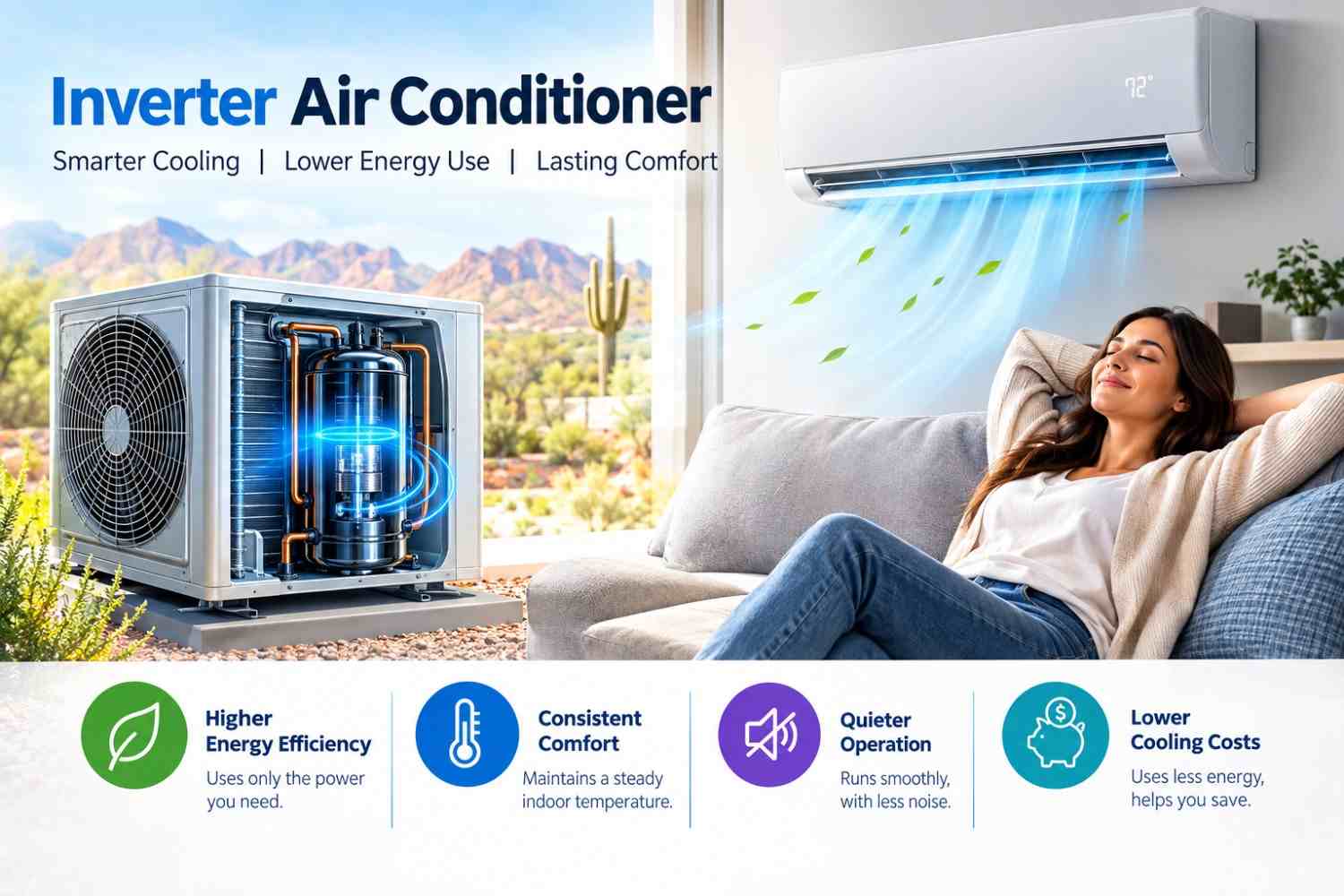
An inverter air conditioner provides efficient, consistent cooling by adjusting the compressor speed to match your home’s cooling needs. Unlike traditional air conditioners that frequently turn the compressor on and off, inverter technology can vary its output to maintain a more stable indoor temperature.
For homeowners in Arizona, where air conditioning can run for long hours during the summer, choosing an energy-efficient AC system can significantly affect comfort and electricity use.
What Is an Inverter Air Conditioner?
An inverter AC uses a variable-speed compressor that can adjust its cooling output instead of running only at full capacity. When your home needs more cooling, the compressor speeds up. Once it reaches the desired temperature, it can slow down and continue operating at a lower capacity.
This approach reduces frequent start-and-stop cycles and lets the system respond more closely to the home’s actual cooling demand.
For homeowners considering a new system, professional AC installation can help ensure the equipment is correctly sized and configured for the property.
How Does Inverter AC Technology Work?
Traditional air conditioners generally use a fixed-speed compressor. The compressor runs at full capacity until the thermostat reaches the target temperature, then shuts off. As the indoor temperature rises again, it starts back up.
An inverter system works differently. Its compressor can continuously adjust its speed based on indoor conditions.
This can provide:
- More consistent indoor temperatures
- Fewer compressor start-stop cycles
- Quieter operation
- Better energy efficiency
- More precise cooling control
According to Consumer Reports, inverter technology can provide quieter operation and improved efficiency compared with conventional compressor designs.
Benefits of an Inverter AC
1. Improved Energy Efficiency
One of the biggest reasons homeowners consider inverter technology is AC energy efficiency. Instead of repeatedly running at maximum output, the compressor can run at lower speeds when full cooling capacity isn’t needed.
This can be particularly useful in Arizona, where cooling systems may operate frequently throughout the year. The U.S. Department of Energy notes that efficiency and potential energy savings depend on factors such as climate, equipment efficiency, and actual usage.
2. More Consistent Comfort
Temperature swings can occur when a conventional AC repeatedly turns on and off. A variable-speed system can make smaller adjustments to its cooling output, helping maintain a more stable indoor temperature.
This is especially useful for bedrooms, living areas, and homes where keeping consistent comfort is a priority.
3. Quieter Operation
Because an inverter compressor can run at lower speeds as cooling demand decreases, the system may produce less noticeable operating noise than a traditional system.
4. Potentially Lower Cooling Costs
A high-efficiency air conditioner can reduce electricity consumption compared with an older, less efficient system. However, actual savings depend on the home’s size, insulation, ductwork, thermostat settings, local electricity rates, and the equipment’s efficiency.
Proper installation and regular maintenance also help keep an HVAC system running efficiently.
Inverter vs. Traditional Air Conditioner
The main difference is compressor operation.
Inverter AC:
- Uses variable-speed compressor technology
- Adjusts output based on cooling demand
- Provides more consistent temperature control
- Can operate efficiently at lower capacity
Traditional AC:
- Typically uses a fixed-speed compressor
- Runs at full capacity when cooling
- Turns off when the thermostat reaches the set temperature
- Restarts when additional cooling is needed
For Arizona homeowners replacing an aging system, comparing efficiency ratings, equipment size, and long-term operating costs is more useful than focusing only on the initial purchase price.
Is an Inverter AC Right for Your Arizona Home?
An inverter system may be a good option if you want energy-efficient cooling, quieter operation, and more consistent indoor temperatures. However, the right system depends on your home’s cooling load, ductwork, insulation, and budget.
Regular HVAC maintenance can also help protect efficiency and system performance over time. If indoor air quality is another concern, homeowners can also explore air purification systems as part of a broader home comfort solution.
Before replacing your AC, have a qualified HVAC professional evaluate your existing system and recommend the appropriate capacity and efficiency level.
For homeowners in Scottsdale, Phoenix, and the surrounding East Valley, Oasis Air AZ provides professional AC installation, repair, and HVAC services to help keep homes comfortable through Arizona’s extreme temperatures.