


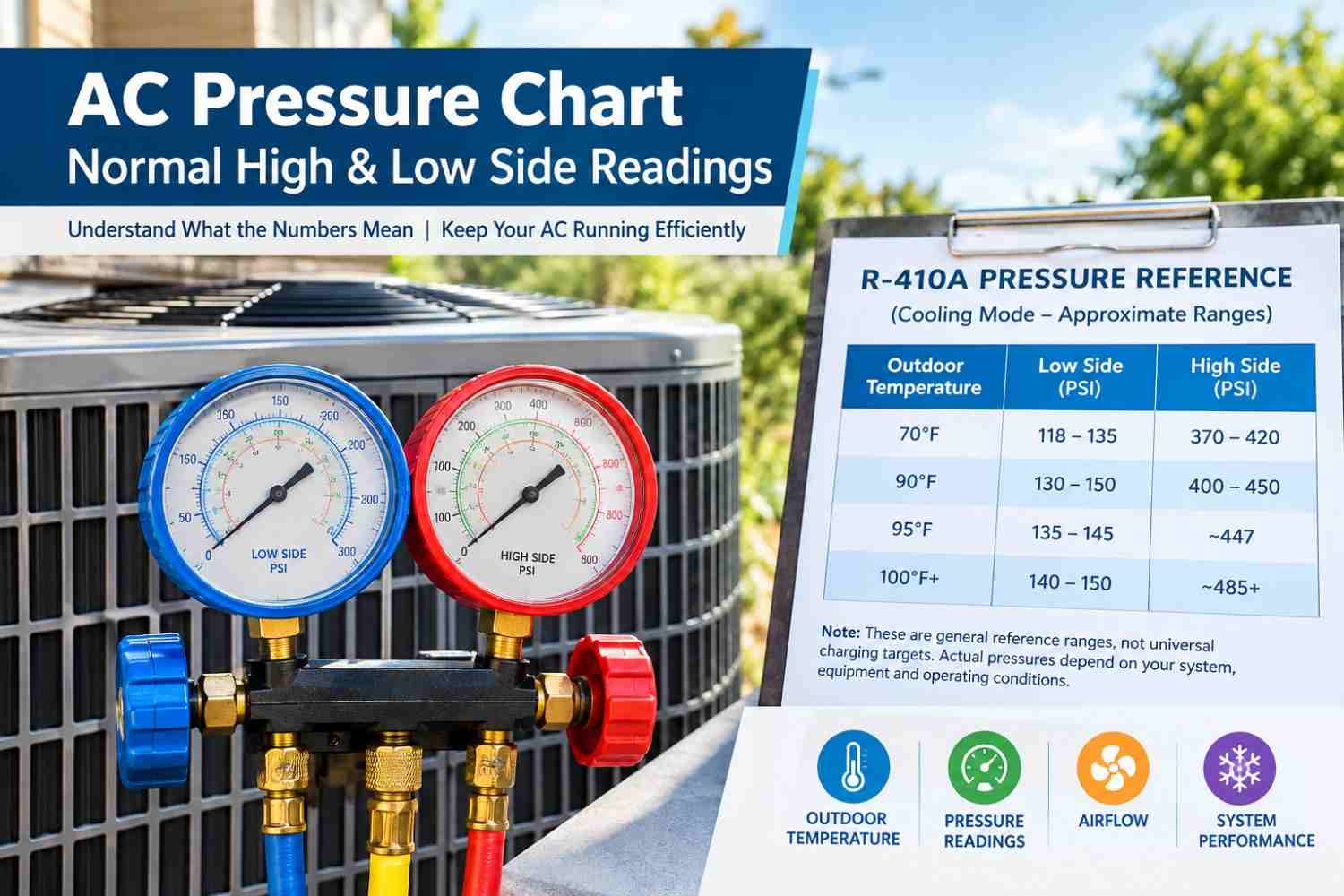
If your air conditioner is running but your home isn’t cooling, refrigerant pressure may be one of the things an HVAC technician checks. An AC pressure chart helps technicians compare refrigerant pressure with temperature and understand whether a system is operating within an expected range.
However, there is no single pressure value considered normal for every air conditioner. The correct reading depends on the refrigerant, outdoor temperature, indoor conditions, airflow, equipment design, and manufacturer specifications.
This guide explains how to read an AC pressure chart, what high-side and low-side pressure mean, how Arizona heat affects AC pressure, and what different readings can tell you about your cooling system.
AC Pressure Chart: Quick Reference
For many residential R-410A systems operating in cooling mode, pressure can vary considerably depending on outdoor conditions.
| Outdoor Temperature | Approx. Low-Side Pressure | Approx. High-Side Pressure |
| 70°F | 118–135 PSI | 370–420 PSI |
| 80°F | Varies by system | Varies by system |
| 90°F | 130–150 PSI | 400–450 PSI |
| 95°F | 135–145 PSI | Around 447 PSI |
| 100°F+ | 140–150 PSI | Around 485 PSI or higher |
These numbers are general reference ranges, not universal charging targets. Actual pressure depends on the equipment and operating conditions.
The most important thing to remember is that an AC should not be charged simply because a gauge happens to show a particular pressure.
What Is an AC Pressure Chart?
An AC pressure chart is a reference tool for understanding the relationship between refrigerant pressure and temperature.
As refrigerant moves through an air conditioning system, it changes pressure and temperature while absorbing heat from inside the building and releasing that heat outdoors.
Technicians may use pressure readings along with other measurements to determine whether an AC system is operating properly.
Important measurements can include:
- Low-side pressure
- High-side pressure
- Outdoor temperature
- Indoor return-air temperature
- Supply-air temperature
- Suction-line temperature
- Liquid-line temperature
- Superheat
- Subcooling
- Airflow
This is why pressure alone cannot always identify the cause of an AC problem.
What Do Low-Side and High-Side AC Pressure Mean?
An air conditioning system has two primary pressure sides.
Low-Side AC Pressure
The low side is generally associated with the refrigerant returning from the evaporator toward the compressor.
It is affected by factors such as:
- Indoor heat load
- Evaporator condition
- Airflow
- Refrigerant charge
- Metering device operation
A low suction-pressure reading can have several possible causes. Refrigerant undercharge is one possibility, but restricted airflow, evaporator problems, and other conditions can also affect the reading.
If your AC is blowing warm air or struggling to cool your home, professional AC repair in Scottsdale can help identify whether refrigerant pressure is actually part of the problem.
High-Side AC Pressure
The high side is associated with refrigerant leaving the compressor and moving through the condenser.
High-side pressure is strongly influenced by outdoor temperature because the condenser must reject heat to the outside air.
Possible causes of unusually high pressure include:
- Dirty condenser coil
- Restricted outdoor airflow
- Condenser fan problems
- Excess refrigerant
- Extremely high outdoor temperatures
- Non-condensable gases
- Other system problems
The complete operating condition needs to be checked before identifying the cause.
R-410A AC Pressure Chart
R-410A has been widely used in residential AC systems, and many existing systems still operate with this refrigerant.
A general R-410A pressure reference during cooling may look like this:
| Outdoor Temperature | Low Side | High Side |
| 70°F | 118–135 PSI | 370–420 PSI |
| 90°F | 130–150 PSI | 400–450 PSI |
| 95°F | 135–145 PSI | ~447 PSI |
| 100°F+ | 140–150 PSI | ~485+ PSI |
These values should not replace the charging specifications provided by the equipment manufacturer.
The supplied competitor reference also emphasizes that pressure changes significantly as outdoor temperature rises, particularly on the high side.
Why Arizona Heat Changes AC Pressure
This is particularly important for homeowners in Scottsdale, Phoenix, and surrounding communities in Arizona.
An air conditioner has to remove heat from your home and release that heat outside. When the outdoor temperature becomes extremely high, the condenser has to work harder to reject heat.
That can increase condensing pressure.
For example, a pressure reading taken on a mild morning should not automatically be compared with a reading taken during a very hot Arizona afternoon.
This is one reason HVAC technicians record outdoor temperature when evaluating refrigerant pressures.
Oasis Air AZ serves Scottsdale and Arizona’s East Valley, where extreme summer temperatures can place significant demands on residential cooling systems.
What Is Normal Low-Side AC Pressure?
There is no universal low-side pressure for every AC system.
For many R-410A residential systems, a general cooling reference may fall around 105–145 PSI, but actual readings can vary depending on the system and conditions.
A low reading may be associated with:
- Low refrigerant charge
- Refrigerant leak
- Restricted airflow
- Dirty evaporator coil
- Metering device restriction
- Low indoor heat load
- Other system conditions
This is why adding refrigerant based only on a low gauge reading can be a mistake.
The technician needs to determine why the pressure is low.
What Is Normal High-Side AC Pressure?
High-side pressure can change significantly as outdoor temperature increases.
A properly operating R-410A system may have much higher head pressure during extreme outdoor heat than during mild weather.
Higher-than-expected high-side pressure can be related to:
- Dirty condenser coils
- Poor condenser airflow
- A failing condenser fan
- Excess refrigerant
- Extremely high outdoor temperatures
- Non-condensable gases
If your outdoor AC unit is dirty or has restricted airflow, the system may have difficulty releasing heat efficiently.
Oasis Air AZ’s AC tune-up service includes inspecting and cleaning major system components, such as condenser coils, to help keep HVAC equipment operating properly.
What Do Different AC Pressure Readings Mean?
Looking at the high and low sides together can provide much more information than looking at only one gauge.
Low Head Pressure + Low Suction Pressure
This pattern can occur with:
- Low refrigerant charge
- Refrigerant leak
- Other system restrictions or operating conditions
Additional measurements are needed to confirm the actual cause.
High Head Pressure + Normal or High Suction Pressure
Possible causes include:
- Dirty condenser coil
- Restricted outdoor airflow
- Condenser fan problems
- Excess refrigerant
- High outdoor temperature
High Head Pressure + Low Suction Pressure
This combination may indicate a restriction in the refrigerant circuit.
Possible causes can include:
- Restricted metering device
- Restricted liquid line
- Plugged filter-drier
Normal Head Pressure + Low Suction Pressure
This pattern may occur when indoor airflow is restricted.
Possible contributors include:
- Dirty air filter
- Dirty evaporator coil
- Blower problems
- Restricted ductwork
The supplied reference material similarly recommends using pressure patterns together with superheat, subcooling,g and other measurements instead of diagnosing from pressure alone.
Can Low AC Pressure Mean a Refrigerant Leak?
Yes, but low pressure does not automatically prove that your system has a leak.
A refrigerant leak can reduce the amount of refrigerant circulating through the system and may cause unusual pressure readings.
Other problems can produce similar symptoms.
If you notice:
- AC blowing warm air
- Longer cooling cycles
- Ice on refrigerant lines
- Poor cooling performance
- Increasing energy bills
A professional inspection can help identify issues before they become costly problems.
Oasis Air AZ specifically lists refrigerant leaks as a common AC repair problem and provides residential AC repair throughout Scottsdale and surrounding East Valley communities.
Can a Dirty Air Filter Affect AC Pressure?
Yes. A severely dirty air filter can restrict airflow through the evaporator.
When airflow decreases, the cooling system does not operate under the same conditions it would with proper airflow. This can affect evaporator temperature and suction pressure.
That is why checking your filter is one of the simple things you can do before calling for AC service.
Oasis Air AZ also recommends checking that the filter is clean when troubleshooting basic AC problems.
Can a Dirty Condenser Coil Cause High AC Pressure?
Yes. The outdoor condenser coil releases heat from the refrigerant into the outdoor air.
When the coil is heavily covered with dirt and debris, heat transfer can become less effective. This can contribute to higher head pressure.
Restricted airflow or a condenser fan problem can create similar conditions.
Regular maintenance can help identify these problems before they contribute to a larger AC breakdown.
Oasis Air AZ recommends regular maintenance and provides HVAC maintenance plans that include professional system care and inspections.
Why Pressure Alone Is Not Enough
A pressure gauge only tells you part of the story.
A system can show a pressure reading that appears reasonable while still having another problem.
Technicians may also evaluate:
- Superheat
- Subcooling
- Temperature split
- Airflow
- Outdoor ambient temperature
- Indoor load
- Refrigerant type
- Manufacturer specifications
The supplied reference specifically notes that pressure alone does not confirm a healthy refrigerant charge and that superheat and subcooling provide additional diagnostic information.
This is why an online pressure chart should be used as an educational reference rather than as a DIY refrigerant charging guide.
Should Homeowners Check AC Pressure?
Homeowners can safely perform basic checks such as:
- Checking the thermostat
- Replacing a dirty air filter
- Making sure supply vents are open
- Checking that the outdoor unit has adequate clearance
- Checking whether the system has power
Refrigerant pressure testing is different.
Working with refrigerant requires appropriate tools, training, and safety procedures. If the AC is not cooling properly, it is safer to have a qualified HVAC technician diagnose the system.
If your system needs professional attention, Oasis Air AZ AC repair is available for homeowners throughout Scottsdale and the surrounding East Valley.
How Often Should AC Pressure Be Checked?
Most homeowners do not need to routinely check refrigerant pressure themselves.
Pressure may be checked when:
- An AC is not cooling properly
- A refrigerant leak is suspected
- A system is being serviced
- Performance problems are being diagnosed
- A technician is verifying system operation
- A repair has been completed
Preventive maintenance is a better approach than waiting until the system develops a serious cooling problem.
Oasis Air AZ recommends regular HVAC maintenance and states that preventive maintenance should be performed at least every six months.
For ongoing maintenance, you can learn more about HVAC maintenance plans in Arizona.
AC Pressure Chart FAQs
What is a normal AC pressure?
There is no single normal pressure for every air conditioner. Refrigerant type, outdoor temperature, indoor conditions, airflow, and equipment specifications all affect the expected reading.
What is normal R-410A pressure?
For many R-410A residential systems, low-side pressure may commonly fall around 105–145 PSI during cooling, while high-side pressure varies substantially with outdoor temperature.
What should R-410A pressure be at 90°F?
A general reference range may be around 130–150 PSI on the low side and approximately 400–450 PSI on the high side. Actual readings depend on the specific system and operating conditions.
What should AC pressure be at 100°F?
At an outdoor temperature of 100°F, R-410A system pressures can be substantially higher than in mild weather. High-side pressure may approach or exceed 485 PSI depending on the system and conditions.
Does high AC pressure mean too much refrigerant?
Not necessarily. High pressure can also result from extreme outdoor temperatures, dirty condenser coils, restricted airflow, condenser fan problems,s or other system issues.
Does low AC pressure mean low refrigerant?
Not always. Low pressure can be associated with low refrigerant, but airflow restrictions, evaporator problems and other conditions can also affect suction pressure.
Can I add refrigerant using an AC pressure chart?
You should not use a generic pressure chart as the sole basis for adding refrigerant. Proper charging requires the correct refrigerant, equipment specifications,ns and appropriate diagnostic measurements.
Why does AC pressure change with outdoor temperature?
As outdoor temperature rises, the condenser has to reject heat into hotter air. This generally causes the condensing temperature and high-side pressure to increase.
Final Thoughts
An AC pressure chart is a useful reference for understanding refrigerant pressures, but there is no single pressure number that proves an AC system is healthy.
Outdoor temperature, indoor conditions, airflow, refrigerant type, and equipment design all influence pressure readings. A proper diagnosis considers the entire system rather than relying on a single gauge reading.
This is especially important in Arizona, where extreme summer temperatures can put significant stress on air conditioning equipment.
If your AC is blowing warm air, running constantly, freezing up, or struggling to keep your Scottsdale home comfortable, professional diagnosis can help identify the actual cause.
Oasis Air AZ provides AC repair, installation, and maintenance services throughout Scottsdale and surrounding communities in Arizona. You can also schedule an AC tune-up to help keep your system operating reliably before Arizona’s hottest weather arrives.