


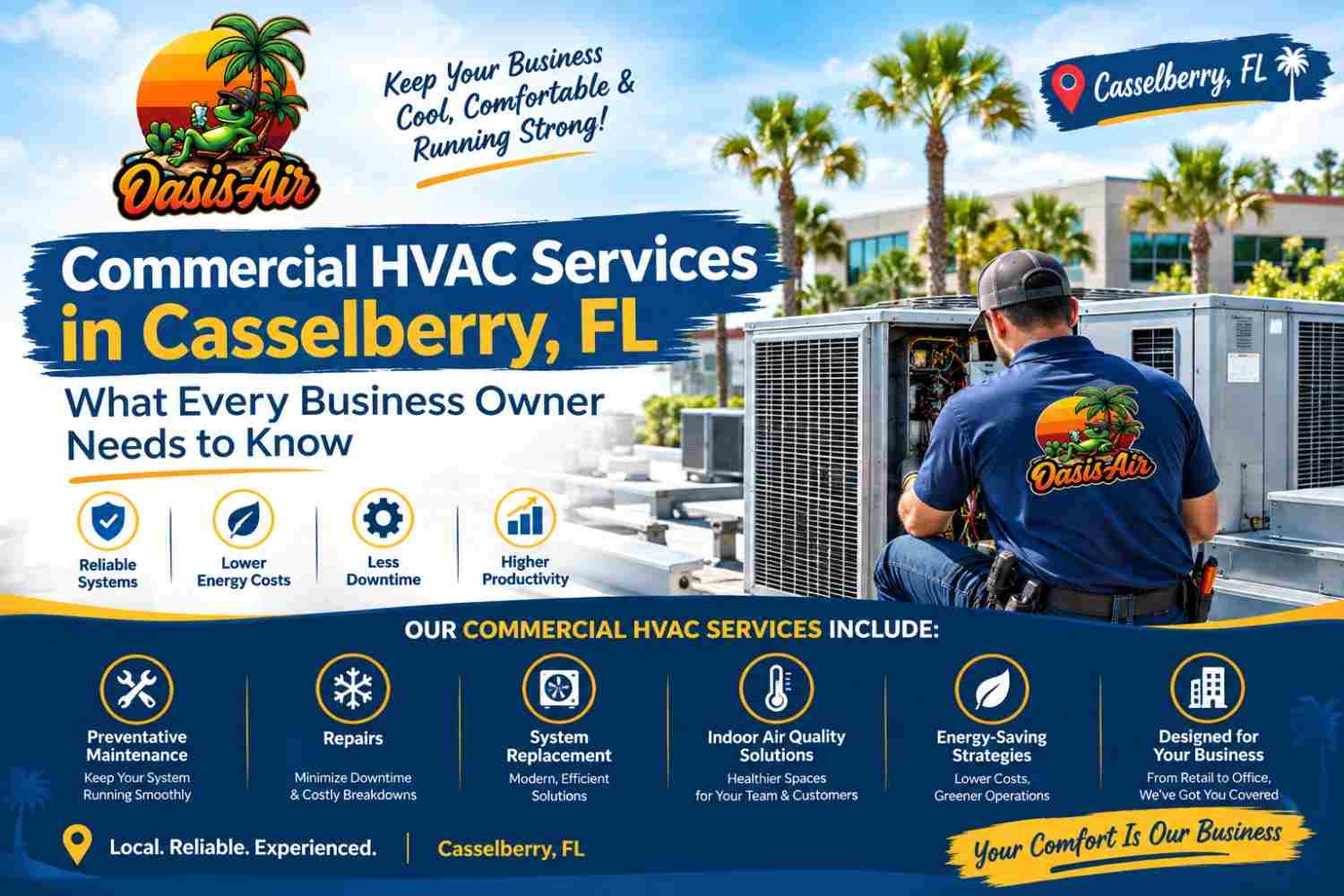
If you run a business in Casselberry, Florida, keeping your building comfortable is not just a matter of employee satisfaction — it directly affects your productivity, energy costs, and even compliance with local health and safety standards. Commercial HVAC systems are the backbone of any well-functioning commercial space, and understanding how they work, what services they require, and how to choose the right contractor can save you thousands of dollars every year.
This guide covers everything local business owners in Casselberry need to know about commercial HVAC services — from routine maintenance to emergency repairs, system replacements, and smart energy-saving strategies.
What Is Commercial HVAC and How Is It Different From Residential?
Commercial HVAC stands for Heating, Ventilation, and Air Conditioning — but commercial systems are very different from the units you find in homes.
Key Differences Between Commercial and Residential HVAC
- Size and Capacity: Commercial systems are significantly larger and built to condition much bigger spaces — from small retail shops to multi-story office buildings.
- Complexity: Commercial units often use rooftop package units (RTUs), chillers, cooling towers, and variable air volume (VAV) systems that require specialized expertise to maintain and repair.
- Zoning Requirements: Most commercial buildings have multiple zones, each needing independent temperature control.
- Modular Design: Commercial systems are often modular, meaning components can be added or replaced without a full system overhaul.
- Drainage Systems: Commercial units have more complex drainage setups to handle the high volume of condensation they produce.
- Regulatory Compliance: Commercial HVAC installations must comply with Florida Building Codes, ASHRAE standards, and Seminole County permitting requirements.
Understanding these differences is the first step toward making informed decisions about your building’s HVAC needs.
Why Commercial HVAC Maintenance Is Critical for Casselberry Businesses
Florida’s climate is brutal on HVAC equipment. Casselberry businesses face high humidity, intense summer heat, and year-round cooling demands that can wear down even the best systems faster than average. Skipping routine maintenance is one of the most expensive mistakes a business owner can make.
The Real Cost of Neglected HVAC Systems
- Higher Energy Bills: A dirty or poorly maintained system works harder and consumes up to 25% more energy than a well-maintained one.
- Frequent Breakdowns: Small issues left unaddressed turn into major, costly repairs — often at the worst possible time.
- Shorter Equipment Life: Most commercial HVAC systems last 15–20 years with proper maintenance. Without it, that lifespan can drop to 10 years or less.
- Poor Indoor Air Quality: Clogged filters, dirty coils, and inadequate ventilation contribute to indoor air pollutants that affect employee health and comfort.
- Loss of Business: A failed HVAC system in the middle of a Florida summer can force you to close temporarily, lose customers, and damage your reputation.
If you want to understand how HVAC air filtration impacts the air quality inside your building, this is a topic worth exploring in depth — you can learn more in our detailed guide on how air filtration improves indoor air quality.
Common Commercial HVAC Services in Casselberry, FL
Whether you own a restaurant, retail store, medical office, warehouse, or office building, here are the core HVAC services your business will need at some point:
1. Preventative Maintenance
Scheduled preventative maintenance is the foundation of a healthy commercial HVAC system. A professional technician will typically:
- Inspect and clean evaporator and condenser coils
- Check refrigerant levels and look for leaks
- Lubricate all moving parts
- Inspect electrical connections and components
- Test thermostat calibration and controls
- Clean or replace air filters
- Inspect belts, pulleys, and fans
- Check drain lines and condensate pans
Most commercial HVAC experts recommend quarterly maintenance visits in Florida due to the climate demands. For a deeper look at what a complete commercial HVAC maintenance plan looks like, check out our guide on commercial air conditioning maintenance.
2. Commercial HVAC Repair
Even with regular maintenance, commercial HVAC equipment will eventually need repairs. Common commercial repair needs include:
- Refrigerant leaks — Cause the system to lose cooling efficiency
- Compressor failure — One of the most expensive repairs if caught too late
- Blower motor issues — Resulting in poor airflow throughout the building
- Frozen evaporator coils — Often caused by restricted airflow or low refrigerant
- Thermostat malfunctions — Can cause temperature inconsistencies across zones
- Electrical component failures — Capacitors, contactors, and relays commonly wear out
- Drainage problems — Blocked drain lines can cause water damage and mould growth
If your system is freezing up, our article on what to do when your AC freezes explains what typically causes this and what steps to take immediately.
3. Commercial HVAC Installation and Replacement
When a system is beyond repair or has reached the end of its useful life, a full replacement is often the most cost-effective option. A qualified commercial HVAC contractor in Casselberry will:
- Conduct a load calculation to properly size the new system
- Recommend the best equipment based on your building type and budget
- Handle all permitting and inspections required by Seminole County
- Properly dispose of old refrigerants per EPA regulations
- Commission the new system and verify performance before handover
Choosing the right system upfront prevents oversizing or undersizing issues that lead to comfort problems and wasted energy. For more on the installation process and what to expect, visit our complete AC installation and repair guide.
4. Indoor Air Quality (IAQ) Services
Commercial buildings can have significant indoor air quality challenges, especially in Florida, where mould, dust, and humidity are constant concerns.
Common IAQ services for Casselberry businesses include:
- Air purification system installation — UV lights, ionisers, and media air cleaners help neutralise airborne contaminants
- Duct cleaning and sealing — Removes buildup of dust, mould spores, and debris from the duct system
- Ventilation system balancing — Ensures fresh air is properly distributed throughout the building
- Humidity control solutions — Dehumidifiers and humidistats help maintain healthy humidity levels indoors
To learn more about the factors that affect indoor air quality in commercial settings, our article is a helpful resource. For businesses seeking advanced air-cleaning solutions, our guide to air purification systems covers the most effective options available today.
5. HVAC System Upgrades and Retrofits
You don’t always need a brand-new system to improve performance. Many businesses in Casselberry are retrofitting their older HVAC systems with:
- Smart thermostats and building automation systems — Allow remote monitoring and scheduling for energy savings
- Variable frequency drives (VFDs) — Reduce energy consumption on fans and compressors
- High-efficiency coils and filters — Improve performance without replacing the full unit
- Duct sealing and insulation upgrades — Reduce energy loss in the distribution system
How to Choose the Right Commercial HVAC Contractor in Casselberry
Not all HVAC companies are created equal. When hiring a contractor for your commercial property, here are the critical factors to evaluate:
Licensing and Insurance
- In Florida, commercial HVAC contractors must hold a Class A or Class B Mechanical Contractor license from the Florida Department of Business and Professional Regulation (DBPR).
- Always verify the contractor’s license is current and in good standing before signing any agreement.
- Make sure they carry both general liability insurance and workers’ compensation insurance to protect your business in case of accidents.
For a detailed breakdown of why licensing matters and what to look for, read our guide on the benefits of hiring a licensed HVAC contractor.
Commercial Experience
Residential HVAC experience does not automatically translate to commercial competency. Make sure your contractor has:
- Hands-on experience with the type of commercial system in your building
- Familiarity with rooftop units, chillers, cooling towers, or other complex commercial equipment
- References from commercial clients in the Casselberry or broader Seminole County area
Our article on what to look for in commercial HVAC contractors provides a detailed checklist to help you vet any company you’re considering.
Service Agreements and Response Time
- Ask about preventative maintenance agreements (PMAs) — these contracts lock in regular inspections at a set price and often include priority service.
- Confirm the contractor offers 24/7 emergency service. A failed AC in August can become a health hazard and business emergency within hours.
- Request a clear commitment on response times for both routine and emergency calls.
Transparent Pricing
Always get a written, itemised estimate before any work begins. Be cautious of contractors who quote prices verbally without documentation or who are vague about parts and labour costs. A trustworthy contractor will be happy to explain what you’re paying for and why.
Understanding Commercial HVAC Terminology
If you’re new to dealing with commercial HVAC systems, some of the technical language can be confusing. Here are a few common terms you’ll encounter:
- Ton: A unit of cooling capacity. One ton = 12,000 BTUs per hour of heat removal.
- BTU: British Thermal Unit — the standard measure of heating and cooling energy.
- SEER: Seasonal Energy Efficiency Ratio — measures cooling efficiency. Higher SEER = more efficient.
- EER: Energy Efficiency Ratio — similar to SEER but measured under specific conditions.
- VAV: Variable Air Volume — a type of HVAC system that varies airflow to maintain temperature.
- RTU: Rooftop Unit — a self-contained commercial HVAC unit installed on the roof.
- Chiller: A cooling system that extracts heat from a liquid using either a vapor-compression or absorption refrigeration cycle.
- AHU: Air Handling Unit — the indoor component that conditions and circulates air.
- CFM: Cubic Feet per Minute — measures the volume of air a system moves.
For a complete glossary of HVAC terminology, our article on common HVAC terms explained is a great reference to bookmark.
Commercial HVAC Energy Efficiency Tips for Casselberry Business Owners
Energy costs are one of the biggest operational expenses for Florida businesses. Here’s how to keep your HVAC-related energy bills under control:
Short-Term Actions
- Replace air filters regularly — A clogged filter forces the system to work harder. Commercial filters should be checked monthly in Florida. Learn more about understanding your HVAC air filter.
- Seal doors and windows — Prevent conditioned air from escaping and hot, humid outside air from infiltrating.
- Use programmable thermostats — Set back temperatures during non-business hours.
- Close blinds and shades — Reduce solar heat gain through windows during peak sun hours.
Long-Term Investments
- Upgrade to a high-efficiency system — Modern commercial HVAC systems are significantly more efficient than units over 10 years old.
- Install a building automation system (BAS) to allow centralized control and monitoring of all HVAC zones.
- Improve building insulation to reduce the heating and cooling load on your HVAC system.
- Consider heat pump technology — Heat pumps are highly efficient for both heating and cooling, especially in Florida’s mild winters. Learn more about AC and heat pump repair and service options.
HVAC Troubleshooting: Common Commercial Problems in Florida’s Climate
Florida’s heat and humidity create specific challenges that Casselberry business owners commonly encounter:
High Humidity Indoors
- Possible cause: Undersized system, improper refrigerant charge, or lack of dedicated dehumidification
- Solution: Have the system rechecked and sized properly; consider adding a commercial dehumidifier
Uneven Cooling Across Zones
- Possible cause: Dirty or blocked vents, duct leaks, or thermostat calibration issues
- Solution: Schedule a full system inspection and airflow balancing
System Running Constantly
- Possible cause: Oversized or undersized equipment, dirty coils, low refrigerant, or extreme heat load
- Solution: Have a technician check the refrigerant charge and coil condition
Strange Noises From the System
- Possible cause: Loose belts, failing bearings, or debris in the system
- Solution: Do not ignore unusual noises — call a technician promptly to avoid further damage
Sudden Spike in Energy Bills
- Possible cause: Refrigerant leak, dirty coils, or a failing compressor
- Solution: Schedule a diagnostic inspection immediately
For more in-depth troubleshooting help, our HVAC system troubleshooting guide covers the most common HVAC issues and what they usually indicate.
Commercial HVAC Financing Options
A full commercial HVAC replacement or major system upgrade can represent a significant capital expense. Fortunately, several financing options are available to help Casselberry businesses manage the cost:
- Equipment Financing Loans — Fixed monthly payments spread over 2–7 years
- Lease-to-Own Programs — Maintain cash flow while getting the equipment you need now
- Energy Efficiency Incentives — Federal tax credits and utility company rebates may be available for high-efficiency systems
- Manufacturer Financing — Many major HVAC brands offer promotional financing through their dealer networks
Before committing to any financing arrangement, compare terms carefully and make sure you understand the total cost of the agreement. For a thorough breakdown of commercial HVAC financing options, read our complete commercial HVAC financing guide.
Seasonal HVAC Considerations for Casselberry Businesses
Florida’s climate means your HVAC system runs year-round, but different seasons bring different demands:
Summer (June – September)
- Peak demand season — systems run continuously
- Prioritise pre-summer tune-ups before the heat arrives
- Monitor energy bills for sudden unexplained increases
Fall (October – November)
- Slightly lower cooling demands allow for easier maintenance scheduling
- Great time to schedule annual inspections and any deferred repairs
Winter (December – February)
- Casselberry winters are mild but can bring occasional cold snaps
- Heating components should be inspected and tested before cold weather arrives
- A good time to schedule duct inspections and sealing
Spring (March – May)
- Pre-cooling season — ideal time for comprehensive maintenance before summer heat
- Check refrigerant levels, clean coils, and replace filters ahead of peak season
Final Thoughts: Investing in Your Commercial HVAC System Pays Off
For any business operating in Casselberry, FL, your HVAC system is one of your most important assets. A properly maintained system keeps employees comfortable and productive, protects equipment and inventory from heat or humidity damage, and keeps energy costs from spiralling out of control.
The key takeaways for every Casselberry business owner are:
- Don’t skip preventative maintenance — it’s far cheaper than emergency repairs
- Hire licensed, insured, and experienced commercial HVAC contractors
- Get written estimates and understand exactly what you’re paying for
- Plan for seasonal needs and schedule service proactively
- Explore financing options so system upgrades don’t have to derail your budget
Whether you’re managing a small retail space or a large commercial facility, the right HVAC partner can make a significant difference in how efficiently and reliably your business operates every day.
Looking to learn more about HVAC systems, maintenance, and best practices? Explore our HVAC blog for expert tips, guides, and industry insights.